First, why your car understeers
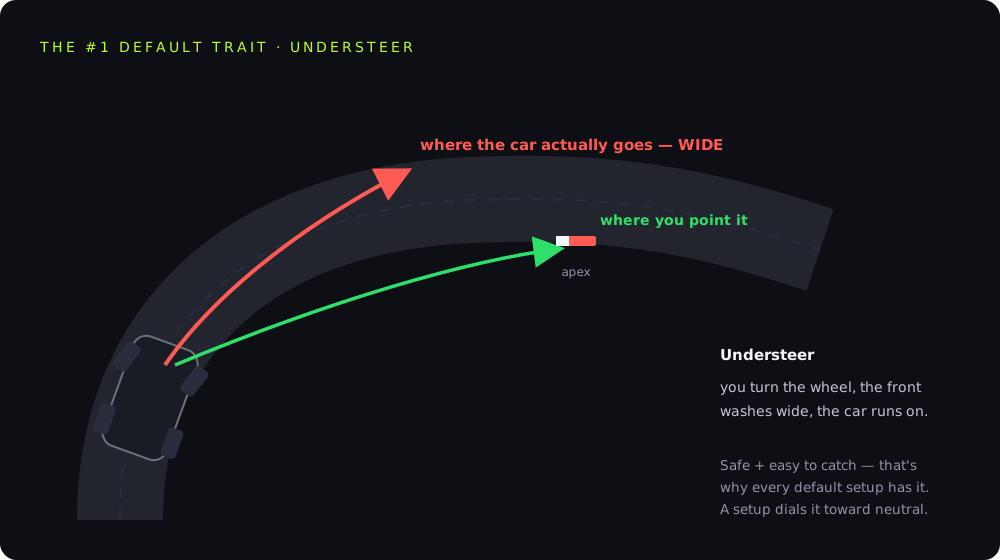
Every game's default setup is deliberately understeery. Understeer — the front washing wide while the rear stays planted — is the safest, most predictable way for a car to lose grip. It's easy to catch, easy to learn, and it keeps a newcomer out of the wall. That's exactly why "how do I fix understeer?" is the number-one setup question in sim racing.
So building a setup is, in large part, dialing that built-in safety margin out toward neutral — as fast as your pace and consistency allow. Do it in the wrong order and you'll chase your tail. Do it in the right order and the car comes to you.
→ Deep dive: how to fix understeer — and make the car you actually want.
Step zero — the app reads everything
You can't tune what you can't see. SimRace.app pulls your entire setup — springs, anti-roll bars, ride height, rake, camber, toe, wing, differential, brake bias, pressures — and a stand of specialist race engineers logs the telemetry, corner by corner, to find the actual errors: where the car understeers, in which phase, on which axle, and whether it's mechanical or aero.
No more guessing from feel alone. You change one thing, the engineers tell you what it did. That's the difference between fiddling and engineering.
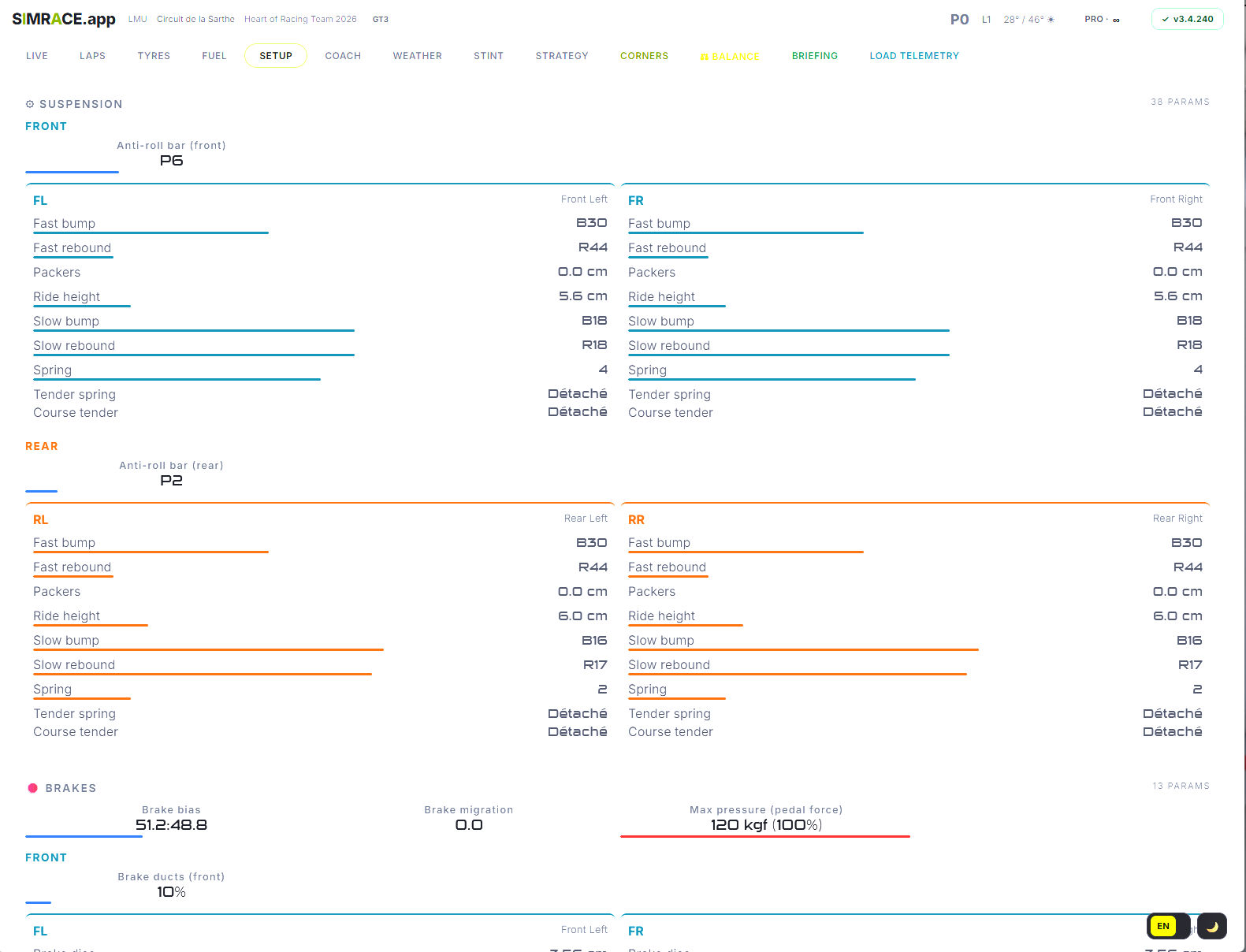
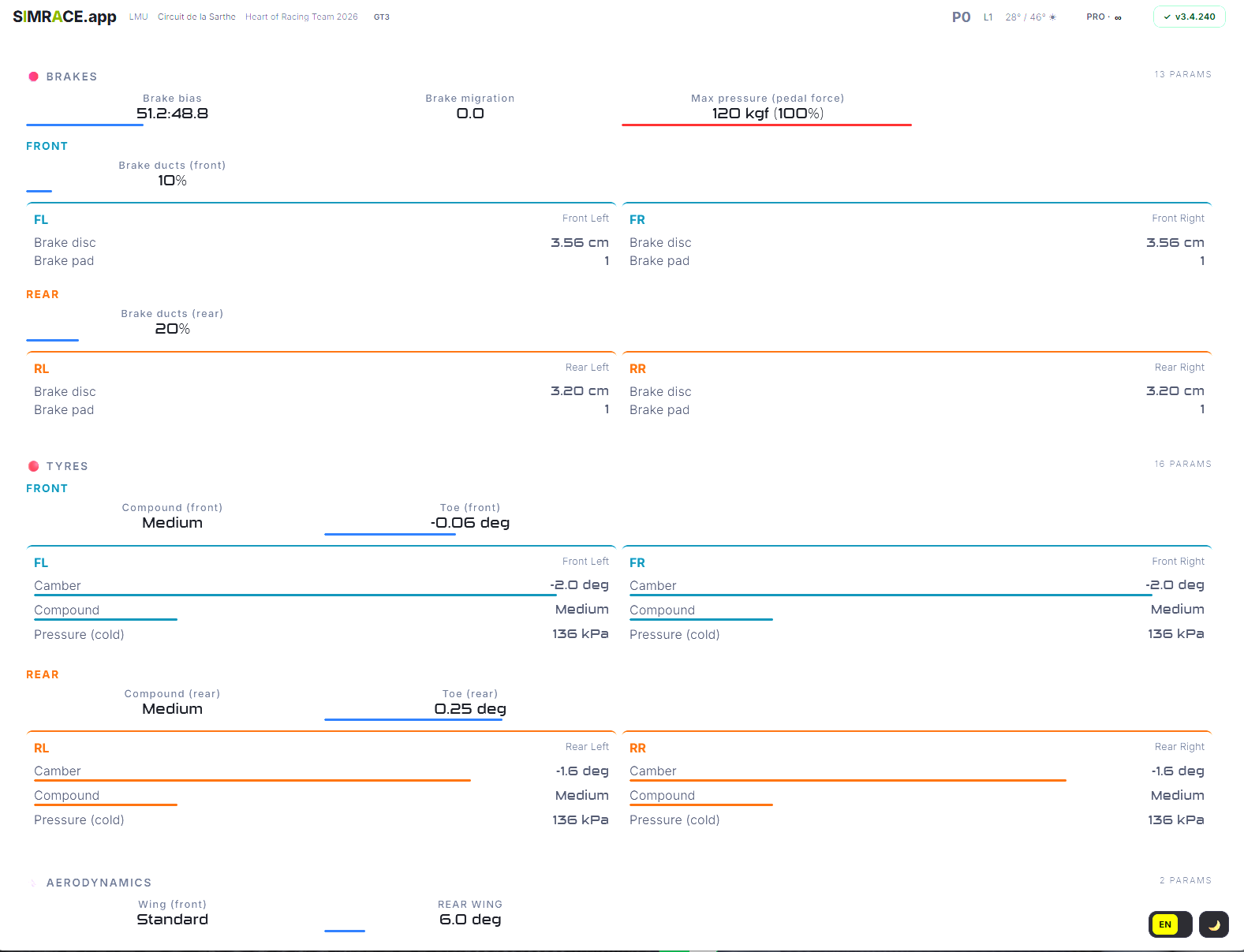
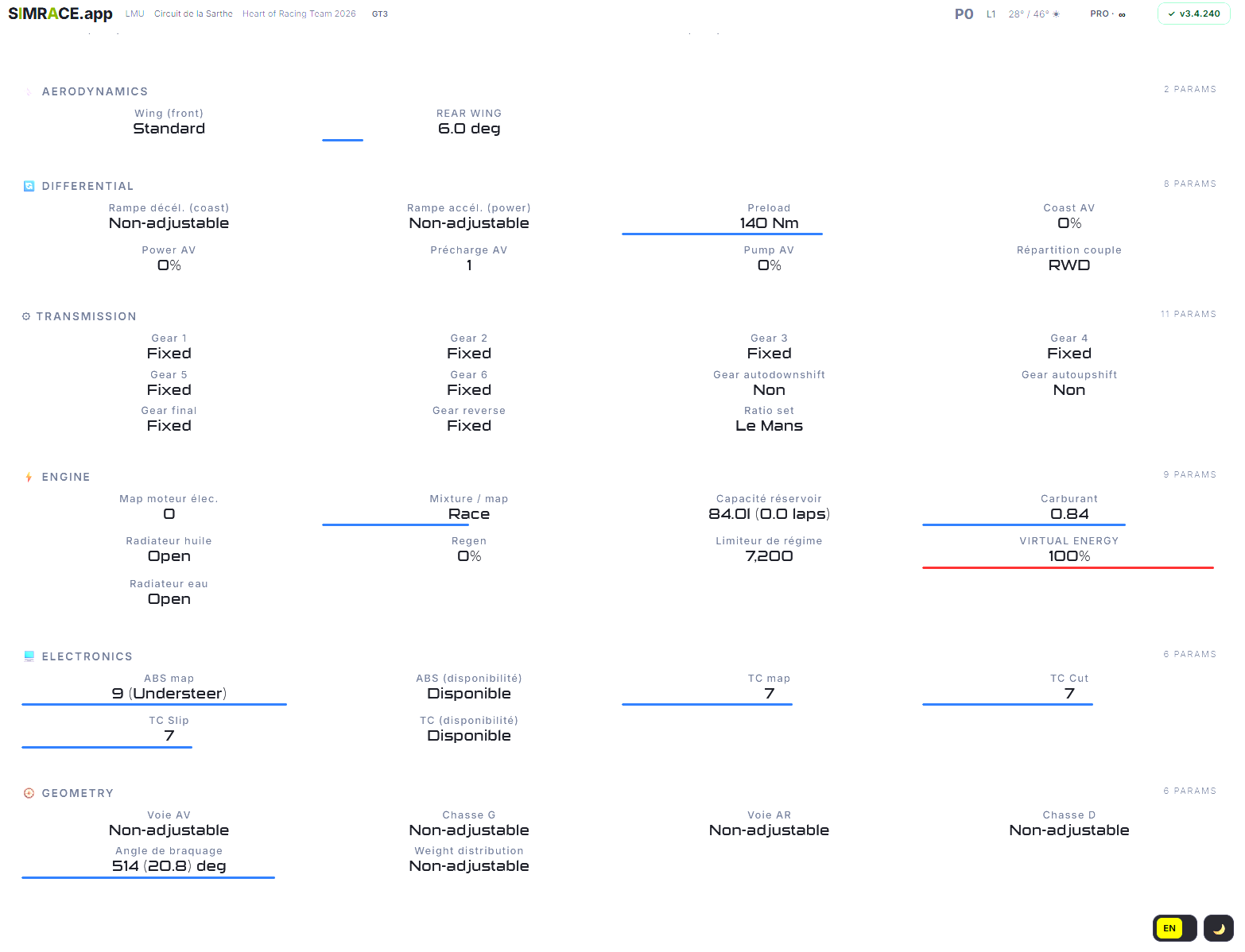
The order that matters — COG, COP, balance, rake
Here's the secret most guides skip: setup levers live in layers, and you tune them in a specific order. The big idea is balance — where the car's load sits — and it has two halves:
- Center of gravity (COG) — where the mass sits, the weight on each axle. It's mechanical and constant (it only shifts as fuel burns).
- Center of pressure (COP) — where the aerodynamic load pushes. It migrates with speed: small in slow corners, dominant in fast ones.
Separating those two is the whole game — and it tells you the order. Rake (rear higher than front) and ride height move the aero balance; anti-roll bars and springs move the mechanical balance. If your problem is speed-dependent, it's aero — so you set the aero platform first, because changing rake or wing afterwards shifts the whole balance and undoes any mechanical work you did first.
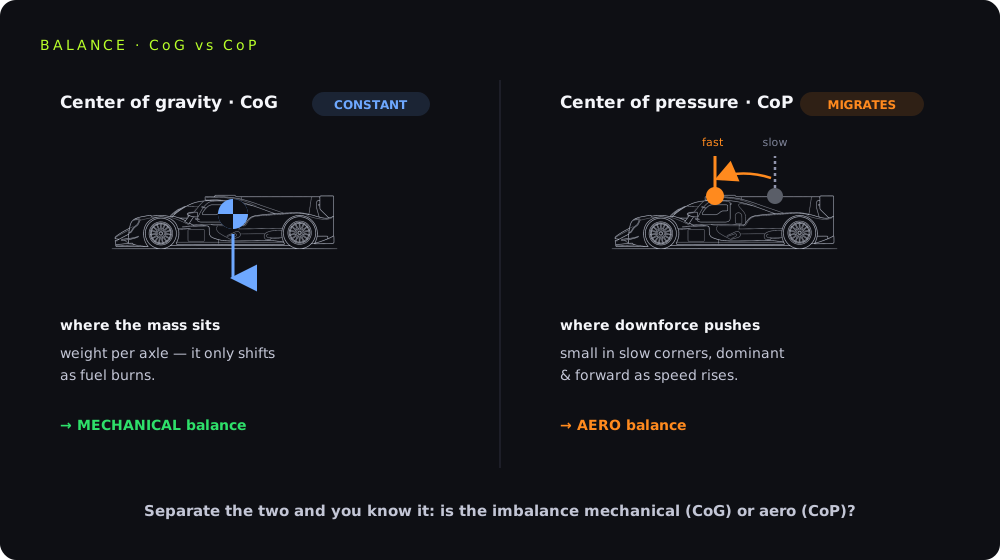
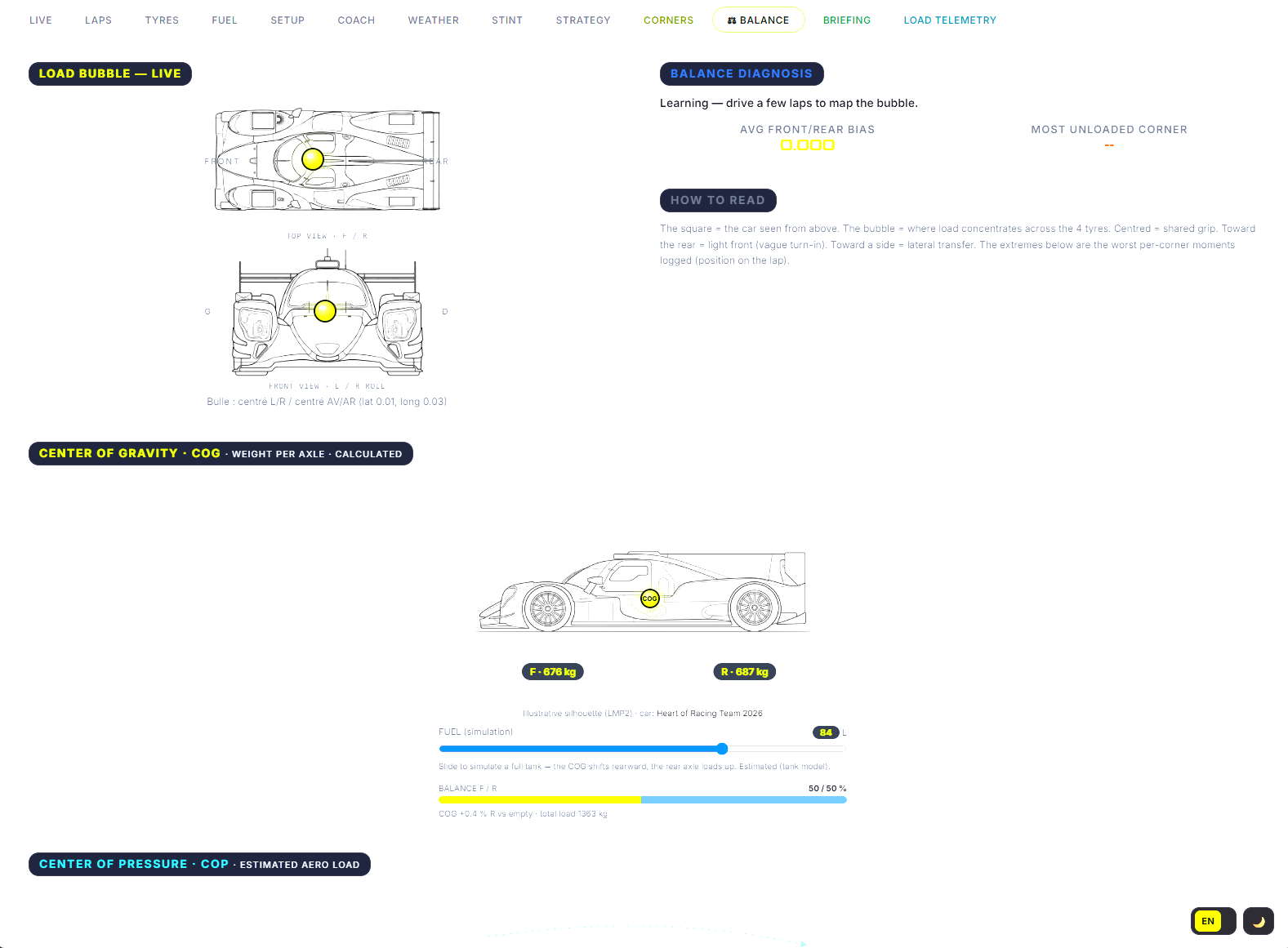
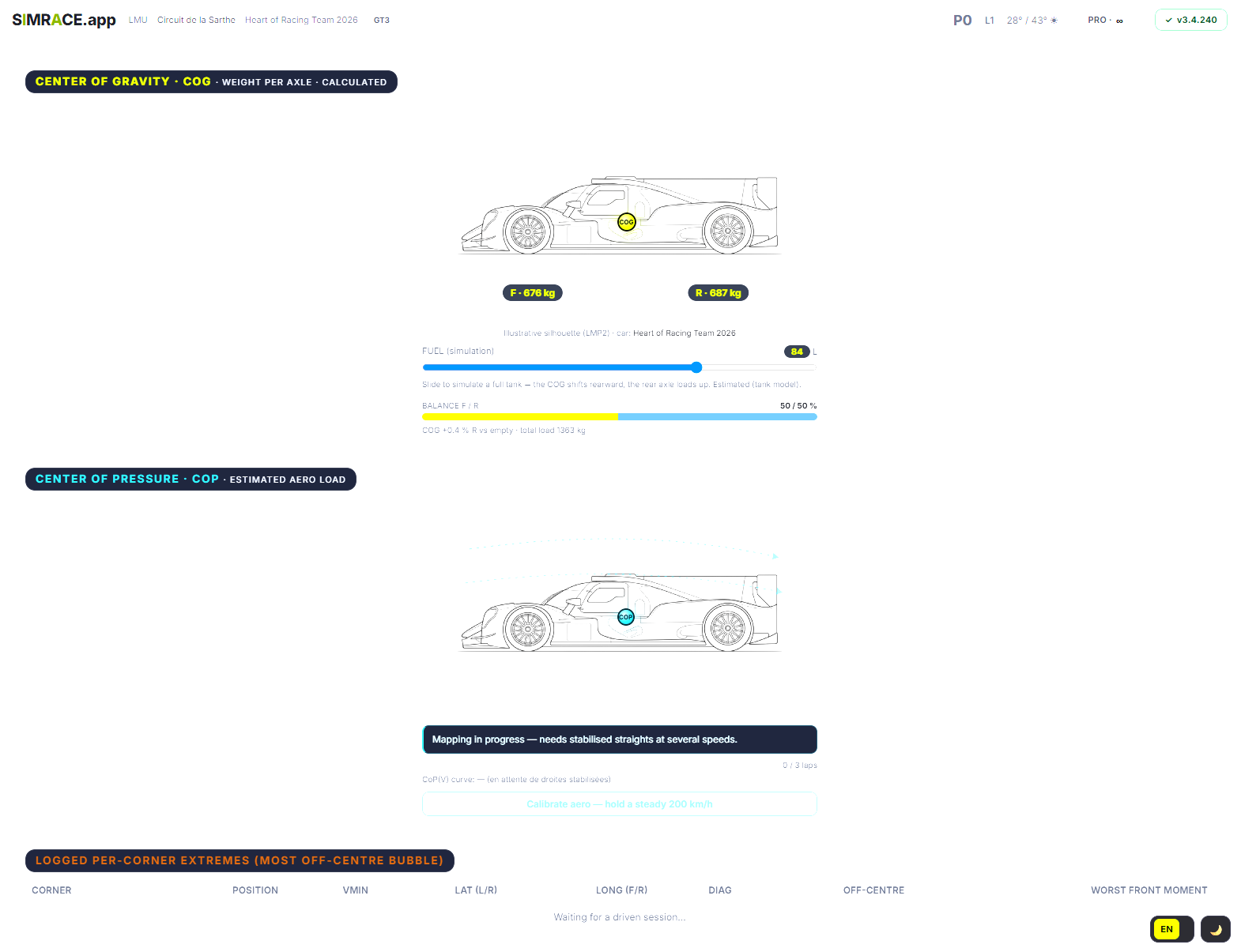
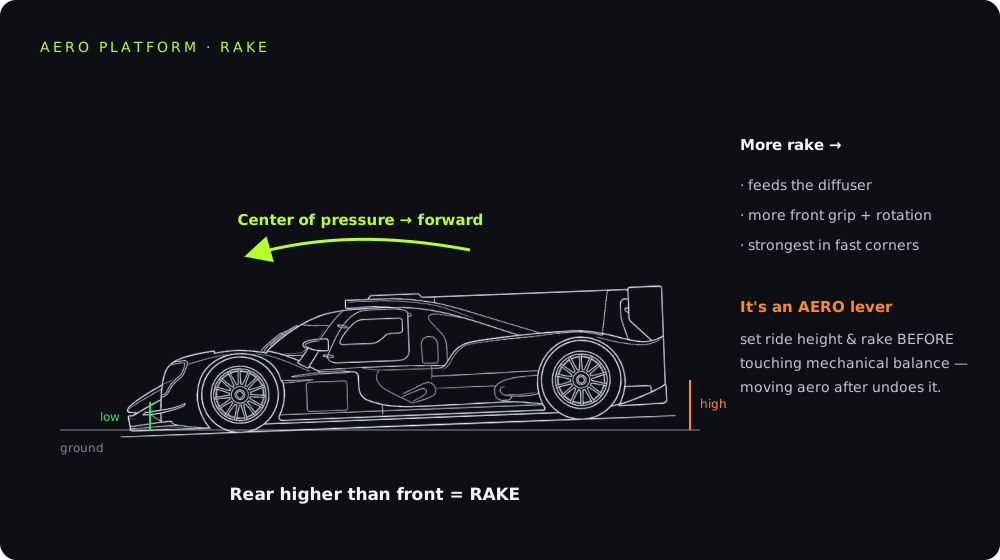
More on this in our dedicated pages on balance and on how we read aerodynamic center of pressure from telemetry.
Understeer & oversteer — read it, then fix it
Once the platform is set, you chase the balance by where and when the car slips — never just "it understeers". Locate it:
- Slow corner vs fast corner — slow is mechanical (anti-roll bar, diff, camber), fast is aero (rake, wing, ride height).
- Entry, mid or exit — entry instability is often dampers or brake bias; exit understeer on the throttle is the diff.
- Which axle — to cure understeer you free the front (soften front bar) or plant the rear; to cure oversteer, the reverse.
And one rule a good engineer never breaks: never load a tyre that's already saturated or overheating. If the rear is grip-limited, you don't stiffen the rear to add rotation — you soften the front instead. Same balance shift, without cooking the tyre. SimRace.app enforces exactly that, and gives you the moves one change at a time.
Suspension, geometry & the rest
With balance set, the supporting levers refine it:
- Springs & anti-roll bars — roll stiffness and its front/rear split; the core of mechanical balance.
- Dampers — a temporary, phased anti-roll bar: they shape the transient (turn-in, getting on the power) without touching the static balance. Tune them last.
- Camber & toe — the tyre contact patch and how the car responds to steering. Optimise within the balance, not against it.
- Differential — preload, power and coast: rotation off-throttle and traction on it.
The gap to the aliens is partly setup
It's tempting to think the fastest drivers are just braver. They're not — or not only. The frontier between pace tiers runs through the setup and the car's overall balance as much as through the driving. A balanced car lets you brake later, carry more mid-corner speed, and — the real difference — repeat it lap after lap without a moment.
That's what the engineer stand is for: it turns your telemetry into an ordered plan — fix this, then this, one change at a time — so the balance work that separates the aliens is no longer a black box.
FAQ
How do I fix understeer in sim racing?
Understeer is the front washing out. Start mechanical for slow corners: soften the front anti-roll bar, open the differential a touch, add a little front camber. If it only shows in fast corners it's aerodynamic — lower the front or add rake. Change one thing at a time and judge it over three laps.
Why are default setups understeery?
Default setups are deliberately safe and stable. Understeer is predictable and easy to catch, so the car is easy to learn. Building a setup is largely dialing that built-in safety margin out toward neutral as your pace rises.
What is rake in a car setup?
Rake is the rear ride height being higher than the front. More rake shifts the aerodynamic center of pressure forward and feeds the diffuser, giving more front grip and rotation in fast corners. It's an aero-platform lever, not a mechanical one.
COG vs COP — what's the difference?
Center of gravity (COG) is where the car's mass sits — the weight per axle — and it shifts as fuel burns: a constant, mechanical balance. Center of pressure (COP) is where aerodynamic load acts, and it migrates with speed. Separating them tells you whether an imbalance is mechanical or aero.
Does setup really matter for lap time?
Yes. The gap between pace tiers — the "alien" pace — is as much setup and overall balance as raw driving. A balanced car lets you brake later, carry more mid-corner speed and stay consistent lap after lap.
Which sims does it work on?
The balance model (COG and COP) is live on Le Mans Ultimate and rFactor 2 today. The telemetry, strategy and coaching layer runs across the SimHub ecosystem including iRacing, Assetto Corsa and Competizione, RaceRoom and Automobilista 2.